Sports Injury Treatment
in Colwood
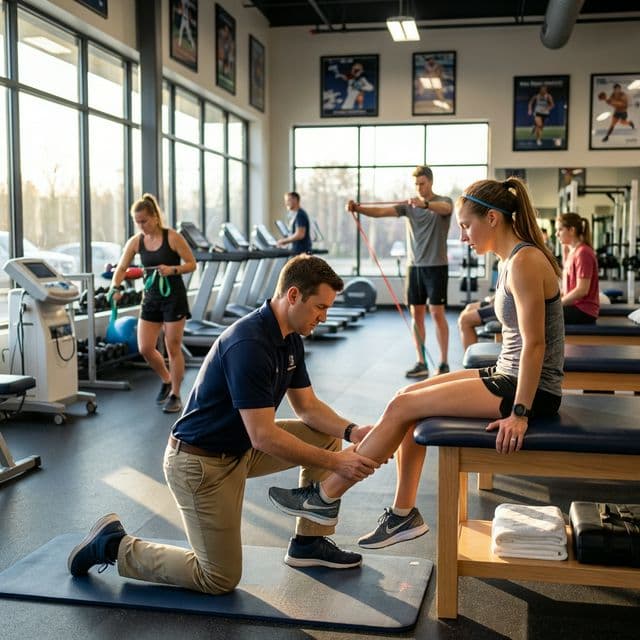
Urgent, performance-focused care. We analyze the root-cause biomechanics of your injury and guide you through active rehabilitation to safely rebuild tissue capacity.
Is This You?
The "Sudden Pop"
You felt an immediate shift, pop, or sharp sensation during an explosive movement, leaving the area severely guarded.
The "Acute Swelling"
A joint or muscle group has rapidly inflamed following an impact or awkward twist on the field or court.
The "Loss of Confidence"
You are afraid to put weight on the injured limb, fearing the joint might buckle or give way entirely.
The "Nagging Pull"
What started as a mild tightness during warmups has evolved into a sharp, restrictive pain when you try to sprint or lift.
Tissue Overload & Biomechanics
A sports injury fundamentally occurs when the physical load placed on a muscle, tendon, or ligament exceeds its current capacity to absorb that force. This can happen instantly (an acute sprain) or build up over time (repetitive strain). By analyzing your baseline biomechanics, we identify why that specific tissue failed and map out a precise pathway to restore its structural integrity.
Our Diagnostic Approach
We don't just guess; we employ clinical testing to isolate the compromised structures.
P.E.A.C.E. & L.O.V.E. Protocol
Managing acute inflammation safely without unnecessarily delaying the natural healing response.
Tissue Loading Tests
Applying specific, measurable forces to tendons and ligaments to assess their current capacity and pain thresholds.
The Sync Difference
Standard massage therapy is excellent for managing generalized tension, but true sports injury rehabilitation requires a dual approach. By combining RMT techniques (managing soft tissue restrictions) with Athletic Therapy principles (active rehab and progressive tissue loading), we don't just reduce your immediate pain—we actively help prevent re-injury when you return to your sport.
High-Value Tip You Can Try Today
Avoid Extended Icing: While ice can aggressively numb initial pain, avoid icing after the first 48 hours of an acute internal injury. Controlled, pain-free movement accelerates fresh blood flow and proper tissue remodeling far more effectively than complete rest or chronic icing.
Explore Related Services
Your Practitioner
Clinical care provided by Daryl Stubbs, RMT & CAT(C). Bringing dual-credentialed expertise in tissue mechanics and active athletic rehabilitation.
Read Full Bio →Award-Winning Care in Colwood
Kind Words from Our Patients
Recent 5-Star Reviews from your neighbors in Colwood & Langford.
Frequently Asked Questions
When should I seek treatment for a sports injury?
It is best to seek clinical assessment within the first 48 to 72 hours of an acute injury. Early intervention helps manage initial inflammation safely and sets a foundation for faster remodeling.
Does treatment hurt?
We prioritize pain-free, controlled movement. While rehabilitating injured tissue may involve some discomfort, we actively communicate to ensure treatments remain within your therapeutic tolerance.
How is this different from regular massage?
Sports injury treatment incorporates active rehabilitation, tissue loading assessments, and the P.E.A.C.E. & L.O.V.E. protocols to actively rebuild tissue capacity, going beyond simple relaxation.